
The Smoke Shop That Changed Tribal Tax Law
Taxes for the Community in the 1980's
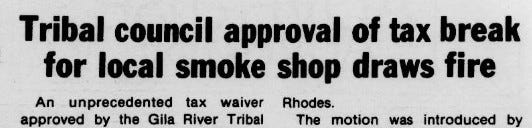
In August 1988 the Gila River Tribal Council did something wild and crazy.
It gave one reservation business a tax break that no other business got.
The vote was 11 to 5 and what followed was almost two years of controversy that ultimately forced the tribe to rethink its approach to taxation from the ground up.
How It Started
The business was the Akimel O’otham Smoke Shop, located near Interstate 10. The owner was Gila River Lieutenant Governor at the time - William Rhodes.
Some important context is that Rhodes was a long-time political fixture in the Community. He was one of the young people that was very instrumental in the implementation of the Vh-Thaw-Hup-Ea-Ju Plan back in the 60’s and 70’s, he was a long time political leader, and in the future he became a very controversial GRIC Governor.
Before we get too far into this story, I want to note that I think Bill Rhodes was an all around awesome dude. Someday I’d like to write more on his life and his massive re organizational change of the Community in the mid 2000’s. He was a visionary guy, and I actually think his argument about tax breaks at this time in our history made a lot of sense.
You see - at the time Rhodes argued to the council that his smoke shop operated differently from other reservation businesses. He paid for his own power through a diesel generator, hauled his own water, and had no tribal road improvements serving the location. He was basically doing everything himself, including his own private security.
As a business owner and a Community member he was asking why he should pay taxes when the tribe was providing very little in the way of infrastructure or support. Whats worse, he employed multiple people and was concerned that without the tax break, he would likely have to close and lay off his seven employees.
The council agreed and reduced his tax rate from 6 percent to 2 percent for three years (09-88, p.1).
The problem was immediate. Renay Peters, who owned MTO Smoke Shop in Sacaton, tried to address the council at the same meeting. He wasn’t recognized before the vote was called and didn’t get to give feedback. He sent a letter to the governor saying the action wasn’t fair. He sent a letter to the tribal treasurer. He requested a hearing. Nothing was resolved (09-88, p.1).
Tribal Treasurer Alida Thomas looked at the tax ordinance and said she saw no provision in the existing law to lower the rate for a single business. “My job is to enforce the ordinance. There’s nothing to cover that in the ordinance,” she said. Without a formal amendment, she had no legal basis to implement what the council had voted (09-88, p.1).
The Decision Goes to Committee
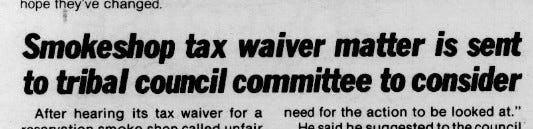
By October 1988 the matter had been referred to the tribal council’s Legislative Committee. This was by itself an interesting development, since it raised questions about whether a committee could review a full council vote. Either way, the community was watching (10-88, p.1).
November 1988 brought a quote that (for me at least) turned out to be the most important line in the whole saga. Mary Thomas, chairperson of the Legislative Committee, was explaining why the committee was taking the tax question so seriously rather than just resolving the smoke shop dispute and moving on. She said: “If we are to run our own government in the future…I believe taxes will always be with us if we want to prepare ourselves for an independent future” (11-88, p.1).
It was a statement that reframed the entire conversation. It wasn’t just this one smoke shop, the questions was about whether the tribe had a coherent, enforceable, and fair tax structure that could support self-governance over the long term.
The Interim Solution
By February 1989 (~6 months later) the council had made a decision. Rather than adjudicate the original tax break or simply deny Peters his hearing, they did something more sweeping — they temporarily reduced the privilege tax for every reservation retailer, down to 2 percent. They also eliminated the separate taxes on alcohol and tobacco products entirely for the period. The change applied to all retail businesses on the Community, tribal and non-tribal alike, and would be active from February 1 to August 1, 1989 (02-89, p.1).
Peters acknowledged it wasn’t exactly what he had asked for, but said the key point had been addressed: “This decision affects all retail businesses on the reservation — while before, it affected only one, and adversely affected all the rest” (02-89, p.1).
The projected cost was about $45,000 in lost revenue over seven months — roughly $7,500 a month. Thomas noted that the committee was already working on ways to broaden the tax base and find alternative revenue to offset the reduction (02-89, p.1).
The Overhaul

The temporary measure bought time for the Legislative Committee to plan next steps.
By October 1989 the GRIN reported that five major changes to the tax law were coming, including a provision specifically for closing the kind of individual waiver that had started the whole controversy (10-89, p.1).
By November, council actually passed seven major tax changes — the most significant reform of the tribal tax structure in the community’s recent history (11-89, p.2). Among them was a blanket prohibition on all future tax waivers. No individual business would be able to get in individual waiver, regardless of the circumstances. There were also a number of other major changes I’d recommend any tax nerds check out.
Conclusion
The smoke shop controversy is a good example of how a seemingly small governance dispute can be the beginning of a larger change.
The original vote wasn’t corrupt — Rhodes made a very reasonable argument about the unique costs of his business and lack of infrastructure the tribe provided… why was he paying taxes when he received little or nothing in return?
I also thought this story was interesting because I think Rhodes had a pretty fair argument to start with - he had paid out of pocket for infrastructure, he was providing jobs to Community members, and he was being asked to pay 4% of his revenue to the Community for… what?
Keep in mind at that time there was no GRPD, GRFD, and many of the infrastructure systems we have today didn’t exist. Rhodes was paying for many of these costs himself - this was not a government enterprise where the Community would come in and bail him out if he got himself 700k in debt… unlike some other ventures of the tribe.
But the council had no mechanism to grant it fairly, no framework for evaluating exceptions consistently, and no way to apply the decision equally across other businesses. When challenged, the waiver didn’t really make sense.
So.. sticky questions coming up in this story - but I think it is a cool look in the evolution of our tax code. And… in the end things worked out. We redid the tax code to make it stronger and we know that Rhodes didn’t end up closing the smokeshop - it remained in business and is still around today. So whatever tax changes they made must have been enough to keep the business around.
Anyway - Thanks for taking a trip down memory lane with me - if you are interested in checking out the stories I used to craft this article you can find them here:
Issue Page Title
09-88 1 Smoke Shop Tax Break Draws Fire
10-88 1 Smoke Shop Tax Waiver Matter Considered by Council Committee
11-88 1 Tribal Committee Continues Work on Tax Question
02-89 1 Tax Controversy Prompts Tribe to Reduce Retail Tax Rate
10-89 1 Major Changes in Tribal Tax Laws Coming
11-89 2 Gila River Approves Seven Major Tax Changes
You can find the full pdf archive on my Gila River News Database or at the original source Gila River Indian News