
The O'odham & Pee Posh Photo Database
How a short presentation turned into tons of archival work
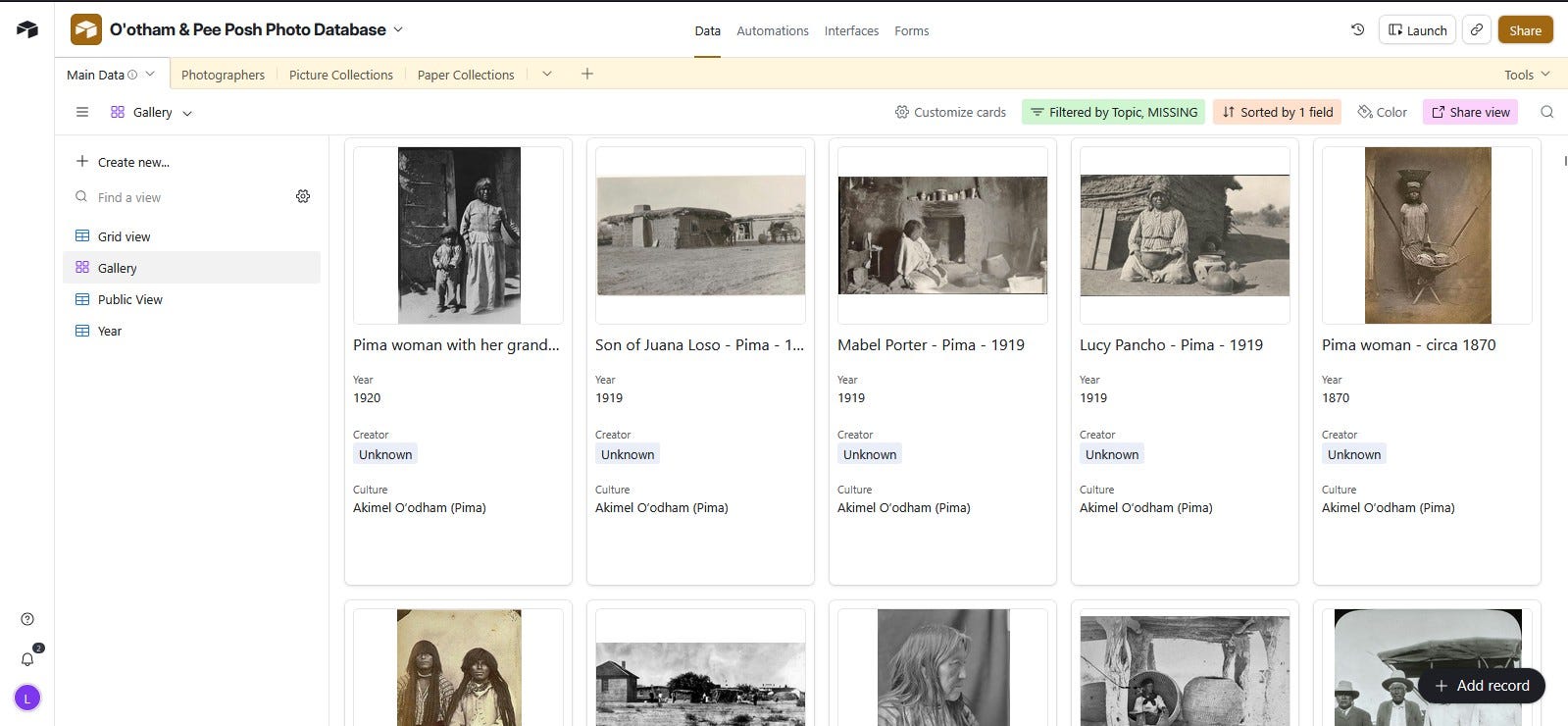
You can view the gallery here or check the full data set here
(Want some COLOR??!! - Check out this explanation of AI Colorization → HERE ← )
What Is the Project?
This is a database of photographs and metadata related to O’odham and Pee Posh history. It brings together images from dozens of archives and collections into one central, accessible place.
Why Did I Do It?
I originally started a version of this project a few years ago while working on my 3D modeling project. I had collected a few hundred images to use as visual references, and that process was one of the ways I first got pulled into history. I had all these incredible photos and no real plan for them. Then, as tends to happen, I got distracted. They mostly sat on my hard drive.
A few months ago, Community Elders asked me to participate in an event and put together a short presentation on how the Community has changed over time. They asked me to find photos to support the topic.
As I started digging through my local files, it hit me that I wanted to give people more context with the images. Who took them? Where did they come from? Who was pictured? What headlines were used? When were they taken?
I had not kept good track of that information, and it felt important to do it right.
I asked around to see if there was a public record of O’odham-related photo collections. I couldn’t find anything easily accessible. HHC and other local archives required in-person visits. Many finding aids didn’t tag or surface O’odham material clearly, it was mixed into larger datasets.
The deeper I went, the more I realized... I’m already doing this work. I should make it easier for the next person. So I put this together.
What’s the Goal?
The primary goal was to create a central, publicly accessible source of archival photos that our Community can access from anywhere, without a gatekeeper.
A secondary goal is to encourage engagement with history. If people want to create an Airtable account and add comments, names, or details, that would be incredible. I found the Ramsey collection and also a large collection of “North American Indians” on Facebook that had a ton of comments from Community members on the photos. I’m hopeful that this could help spark some of that same conversation.
But even if nothing else happens, I want people to be able to browse these collections and, if something catches their interest, have a direct link to request a high-quality copy from the original archive.
How Could You Use This?
I see three main uses.
Browse it. Scroll through the gallery. Group photos by year or location. Sit with them. Enjoy the history. Maybe do some research on the photographer and the time period.
Use the images for teaching or storytelling. Under fair use principles, non-commercial, educational, and research use should generally be acceptable. That said, I strongly recommend checking with the original rights holder and requesting a higher-quality copy when possible. Either way, use the photos for community presentations or to teach folks about our history.
Digitize more! I pulled together material from across the internet, but there is far more out there than I could ever capture. One benefit of this database is that it helps identify what exists and what is still missing. If you know of collections I missed, let me know and I will try to add them.
However you use it, please be respectful of the photo subjects and the wishes of the families involved.
How Did I Do It?
The process was fairly straightforward, but time-consuming.
First, I conducted wide-ranging internet searches across major archives and public-facing collections. I used Pima, Papago, and Maricopa as main keywords along with a lot of other variants (O’otham, O’odham, Pee Posh, GRIC, SRP, TON, etc.). Similar to the O’odham Learning Library, I figure we are all closely related, so it made sense to cast as wide a net as possible.
Then I used AI to supplement the research. I used ChatGPT 5 Pro’s “Deep Research” tools to identify additional archives and O’odham or Pee Posh-related photos. I burned through several months of credits experimenting with different search strategies. I found a lot of really cool small collections and projects I’d never seen before. Found a lot of other cool archival docs I’m looking into as well, but that’s a story for another article.
Next, I downloaded low- or mid-resolution images and attached them to Airtable. I intentionally avoided high-resolution downloads to save space and to strengthen the fair use case for the database. The idea is to give a sample visual of the photo so users can go to the original source to request official use.
Metadata was copied from source websites and run through ChatGPT to generate standardized data tables. If you are curious, I link to my primary prompt HERE.
Most of the work was manual. Entering records one by one. Moving photos around. Tracking down sources. I also restructured large portions of archive finding guides so they could live inside the database, including notes for images that exist but are not yet digitized.
A quick note on AI. Without it, this project would have taken far longer. Trying to standardize dozens of archives manually would have been soul-crushing. AI made it easier, but not easy. Most archival websites are optimized to block automated access, so I couldn’t simply scrape and automate. In the end, manually reviewing each photo and metadata entry helped reduce errors and hallucinations, and it also let me learn a ton about each photo.
It’s not perfect. But it’s a pretty good start.
How Long Did It Take?
This was another nights, weekends, and free-time project. I estimate roughly 200 to 250 hours. Holiday breaks around Thanksgiving, Christmas, and New Year made a big difference in pushing it across the finish line. My poor kids had to put up with me having my nose in my laptop for the past few months.
It helped that this was a second-screen project. I made it through a lot of background TV while working, and I finally started Stranger Things with the kids, so at least there was some family time during this project.
I’m not going to get into all the weird technical stuff I had to learn either. Moving attachments around in Airtable was nightmarish. But it’s good knowledge to have whenever I go back to the OLL or other projects for updates.
How Could the Database Be Better?
There is a lot of room to grow.
More collections. There are many undigitized or inaccessible collections I would love to add. The Smithsonian has a lot, and the Arizona Historical Society and Arizona State Museum hold materials I couldn’t include because I couldn’t find very robust finding guides. And to be really clear, this is a tiny sample of what’s out there. There are hundreds and thousands of images at HHC and at other archives across the country. But ain’t nobody got time for all that, so at least this is a start.
More recent photos. I focused heavily on older material due to copyright and collection size, but there are incredible photos buried in government reports and departmental archives that deserve to be included. Local newspapers are another major gap. The Pima Maricopa Echo and later papers contain fantastic images I would love to add someday.
Community photos. These are the trickiest but potentially the most important. Much of this database reflects an outsider perspective. I would love to find a respectful way for families to contribute their own photos and narratives.
A proper front-end. Someone smarter than me could turn this into a beautiful, intuitive interface. Long term, it would be incredible if HHC or another organization could build this into something more polished and maybe formalize relationships with archives so photo requests could be directed through the tribe, rather than Community members having to go to these archives on their own.
Before You Dive In: A Content Warning
A warning up front. Some of these materials are sensitive, and some are outright racist.
You will see titles and captions like “A Pima Squaw” or “Primitive Housing.” History is not always pretty. I strongly encourage you to explore the context surrounding these photos, captions, and descriptions. In many cases they are dehumanizing or demoralizing.
The people taking these photos were not always enlightened. Many were operating within colonial, extractive, or openly racist frameworks. Still, I am grateful that these images exist at all. They give us something tangible to reflect on, critique, contextualize, and reclaim.
At the same time, our ancestors endured all of this so that we could be here today. I encourage you to celebrate how far we have come and recognize the hard work we are all building on. Now it is up to us to make the future even better for our future generations.
If you are interested in helping add context to these photos, such as identifying people, places, or correcting descriptions, I invite you to participate. You can sign up here: Sign up to contribute
On Nudity and Sensitive Imagery
I struggled with how to handle this enough that it felt worth addressing directly.
For those familiar with our history, you know that it was common for women to be topless during parts of the year, wearing only a grass or cotton skirt or maybe a wrap-around. Some of these photographs reflect that.
Reading Aleta Ringlero’s dissertation helped me better understand how many historic photographs were deliberately staged to frame our ancestors in a specific way: uncivilized, unkept, poor, broken. Or as simple sexual objects.
So I am conflicted. On one hand, some images are manipulated or falsified. On the other hand, they depict real people from our Community. And staged or not, they have existed publicly for over a century and do attempt to show a reflection of Community history.
With that in mind, I chose to keep these photos in the database but clearly tagged them as Not Safe For Work (NSFW) so they can be filtered out. I tried to label images involving nudity, human remains, or graphic content the same way, but please let me know if I missed any. You should be able to choose how you engage with this material, and I hope this approach helps.
Final Thoughts
Before closing, I want to give a huge thank you to Carol Shurz and Linda Andrews. Both invited me to be part of their event, and that unknowingly sparked this project. Also a huge thank you to my family who had to put up with me being hyper-fixated on this over the holidays.
I hope this database is useful. I discovered so many powerful images that will inform future projects, and now I know exactly where to request proper high-quality copies instead of relying on pixelated scans from forgotten corners of the internet.
Hopefully this project helps you find our history easier, makes it easier to engage with, and easier to carry forward and share.
I hope you enjoy it, and I hope it supports your education, research, and storytelling.