
87-89: Origins of GRIC Youth Council (AOPPYC)
The Young People Who Wouldn’t Wait
It started with a group of young people who set up an office in the District 3 Service Center and started planning a cookout.
That’s not quite the origin story you’d expect for what became one of the more enduring institutions in the Gila River Indian Community, but that’s what the June 1988 GRIN shows.
Just a group of volunteers calling themselves the Gila River Youth Advocates, promoting the idea that young people on the reservation deserved a voice — and doing something about it (06-88, p.2).
The First Conference
Before the formal Youth Council existed, there was the A’kimel O’odham Youth Conference.
The August 1987 GRIN announced the first one — scheduled for August 19 and 20 at the Gila River Career Center. The conference theme was “Indian youth, voice of today, leaders of tomorrow.” Workshops would focus on leadership skills, self-image, communication, decision-making, cultural awareness, and educational opportunities (08-87, p.2).
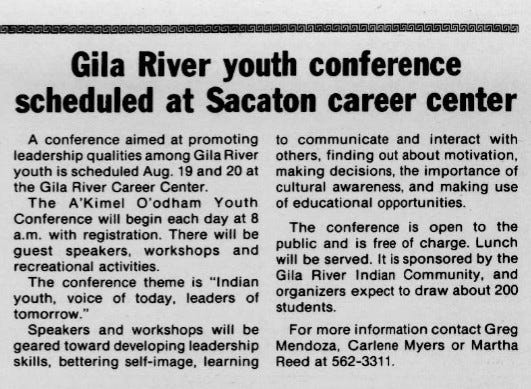
The contacts listed for that conference were Greg Mendoza, Carlene Myers, and Martha Reed.
The same core group that would go on to form the Youth Advocates the following year.
The Founding Members
With the first conference under their belts the Advocacy group began forming into something more official. The founding group is documented by name in the June 1988 issue.
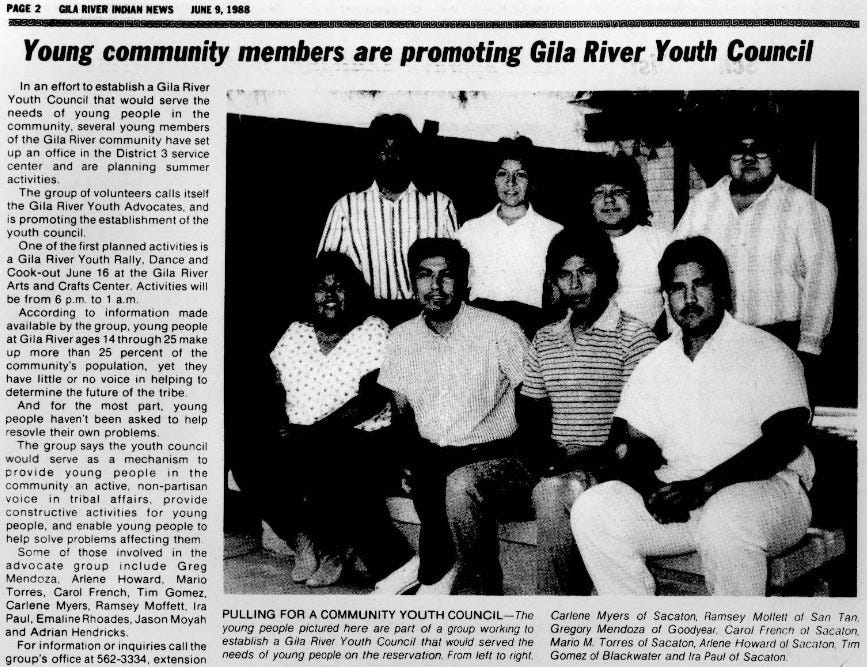
From left to right in the picture:
Carlene Myers of Sacaton
Ramsey Moffett of San Tan
Gregory Mendoza of Goodyear
Carol French of Sacaton
Mario M. Torres of Sacaton
Arlene Howard of Sacaton
Tim Gomez of Blackwater
Ira Paul of Sacaton
A few of these names will already be familiar if you read other GRIN issues from this period. Arlene Howard had just completed her term as Miss Gila River 1987-88, she wrote an open letter to the community in February 1988 encouraging young women to apply for the title and talking about how it had shaped her sense of civic purpose and sharpened her O’otham language skills.
And Greg Mendoza — well, Greg Mendoza had a lot of presence in this period of the newspaper, but we will get back to him later.
Forming the Council
In the June 1988 issue the Youth Advocates were publicly pushing for formal establishment of the Akimel O’odham/Pee-Posh Youth Council. Their stated argument was direct: young people ages 14 through 25 made up more than 25 percent of the Community’s population, yet had “little or no voice in helping to determine the future of the tribe.” And for the most part, young people hadn’t been asked to help resolve their own problems (06-88, p.2).
The council would serve three purposes, they said: provide an active, non-partisan voice in tribal affairs; create constructive activities for young people; and enable young people to help solve problems affecting them.
One of their first planned activities was a youth rally, dance, and cookout on June 16 at the Gila River Arts and Crafts Center. Low-key, community-centered, practical. That’s consistent with how this whole effort was started - showing up and doing things.
The Second Conference
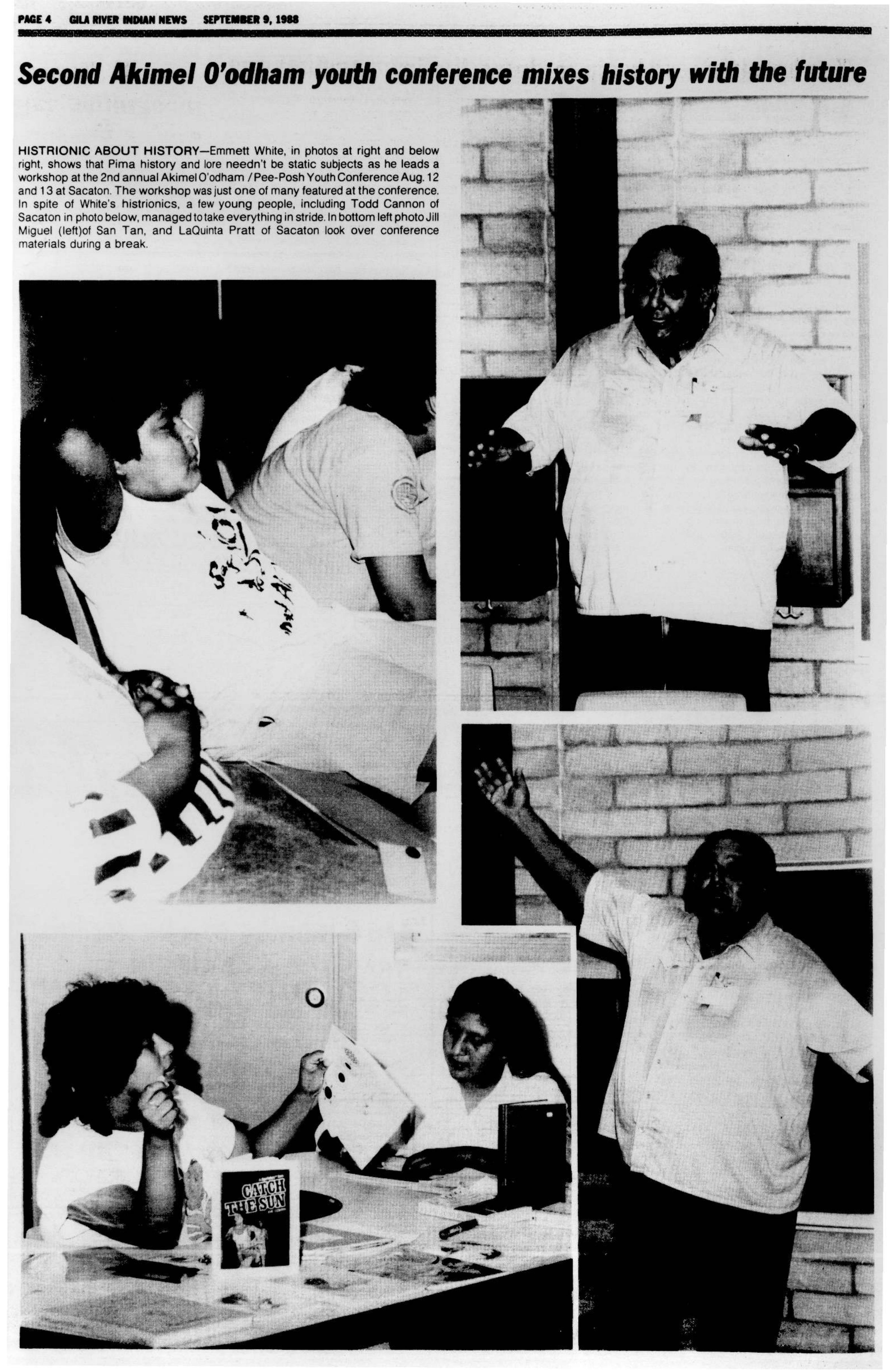
The Youth Advocacy Group, now fully established and holding smaller events in the Community also planned and held the second Youth Conference in August 1988.
This time the conference drew about 200 students and the format expanded significantly — a 2-mile fun run, workshops on tribal culture, tribal government, sex education, substance abuse prevention, family values, a basketball tournament, volleyball, a talent show, and a banquet.
The conference also included the first election of district representatives to the newly forming youth council (08-88, p.1).
The Council Takes Shape
By September 1988 the GRIN carried a letter to the editor from Mendoza — now identified as “advocate, Akimel O’odham/Pee-Posh Youth Council” — reflecting on the second youth conference with obvious pride.
He wrote about witnessing “tremendous growth and positive self-discovery as they took on the challenges and obstacles placed in front of them.” One youth at the conference sent a message he quoted: “We always hear our leaders tell us we are the leaders of tomorrow. I don’t believe that! We are leaders already today, and it is today that is going to make a difference for all Indians” (09-88, p.6).
The AOPPYC structure came into focus in December 1988. The GRIN ran a full article on the Akimel O’odham/Pee-Posh Youth Council with a group photo and a list of elected officers and district representatives.
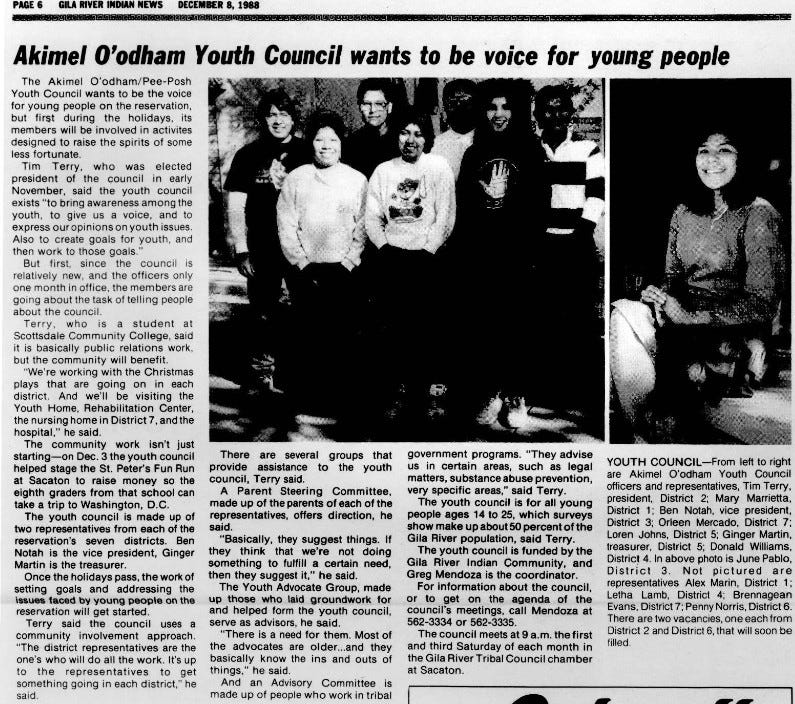
First Youth Council Presidency:
President - District 2 - Tim Terry
Vice President - District 3 - Ben Notah
Treasurer - District 5 - Ginger Martin
District representatives named in the article were :
District 1 - Mary Marrietta and Alex Marin
District 3 - June Pablo
District 4 - Donald Williams and Letha Lamb
District 5 - Loren Johns
District 6 - Penny Norris
District 7 - Orleen Mercado and Brennagean Evans
Two vacancies remained in Districts 2 and 6 (12-88, p.6).
Letha Lamb’s name might ring a bell — she had been profiled in August 1987 as a 14-year-old gymnastics prodigy who had just returned from a dance tour in Russia. By late 1988 she was a district representative on the Youth Council.
I didn’t see any specific articles on any of the other members in this period.
December 1988 is also when the Youth Council got it’s first official Coordinator in Greg Mendoza. He was hired into the Office of Planning and Evaluation (OP&E) as the first Youth Council Coordinator.
The council structure also had three supporting layers:
a Parent Steering Committee made up of the parents of each representative;
the Youth Advocate Group — the original founders — serving as advisors; and
an Advisory Committee of tribal government program staff.
Terry described the Advocates’ role as: “Most of the advocates are older…and they basically know the ins and outs of things” (12-88, p.6). The steering committee and Advisory Committee were less clear from the articles.
AOPPYC Fully Formed
And…. that is part of the origins of the AOPPYC - it started as a group of concerned young people who wanted to make sure that young people were in some part of the decision-making process. It was all volunteer to start with, but we see that eventually there was some government support given to the group and now it’s a well-established and long-running government department.
Would love to hear more from any of the old-timers that were part of starting things. Crazy how many of these folks are now on the edge of being elders now - 40 years later!
But that is all I found on the group during this period.
Another related story worth discussing here is the story around Greg Mendoza. I mentioned him earlier as a founding member of the Youth Advocates, but his history from before the group is interesting too.
Greg Mendoza: Background
Not to make this a Greg Mendoza biography - all the early volunteers had a pivotal role in getting this organization started, but Mendoza had a number of articles about him at this time and … well, he did eventually become Governor….
Anyway - Ok - so by the time the Youth Advocates formed in 1988, Mendoza was already visible in the Community. The GRIN had been running his letters to the editor since mid-1987, and each one showed a person who had been thinking seriously about the community’s future for a long time.
But his backstory - at least in these papers, actually starts in February 1987, when the GRIN ran a photo of Governor Donald Antone congratulating Mendoza for winning a Congressional Award — the only award the U.S. Congress presents to young people in recognition of voluntary public service and personal excellence (02-87, p.1).
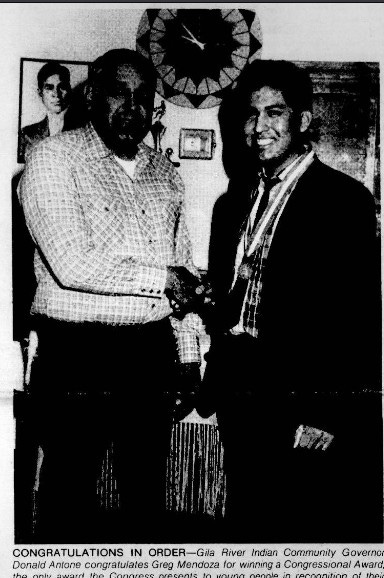
Mendoza was 21 at the time, a junior at Arizona State University majoring in political science, and working full-time at a Phoenix marketing company while carrying a full course load. His days regularly ran from 7:30 a.m. to 10 p.m.
To qualify for the Congressional Award’s medal level, he had accumulated 1,007 volunteer hours even though the requirement was only 400. He also logged 4,160 hours of personal development activities against a requirement of only 200.
(Side note - these awards are still available today. A great goal for youth to work toward: https://www.congressionalaward.org/the-program)
In a profile published with the award announcement, Mendoza talked about overcoming shyness by taking a speech class in high school.
“I took a speech class, and it gave me the opportunity to speak before non-Indians, it gave me the opportunity to speak about my culture, it gave me the opportunity to speak about my community,” he said. “I got more involved with school affairs, and just about practically everything else I could. I just had to overcome my shyness” (02-87, p.2).
He was clear that his interest in Pima history and culture came from not knowing it growing up. He’d had to research and study what others might have absorbed growing up and he was thirsty to learn and give back where he could.
And even at this point in his life he was already talking about going into Community politics someday. His early goal was to being back his education and help the Community, and he was most focused on fellow Youth and their struggles.
The Letters
Mendoza’s had a whole series of letters to the editor through 1987. He wrote so consistently The GRIN editor (Urban Giff) at the time noted that his letters were quickly “becoming a recurring section of the paper”.
July 1987 brought a lengthy vision statement addressed mainly to the youth of the community. Envisioning an America where Indian poverty and unemployment were no longer defining conditions, where young people excelled across every field, where infighting and factionalism gave way to cooperation.
“I envision a more self-sufficient people — doing all they can for themselves instead of looking to the Federal government or some other source to solve all the problems,” he wrote. “I envision the Gila River Indian Community to be that strong and effective tribe which serves as a vehicle through which Indian youth of this community come together, get acquainted, exchange ideas, and work cooperatively to build a great future” (07-87, p.6).
By August 1987 he was writing about alcohol with the concern of someone who had watched it damage people he knew. He talked about attending an Indian conference in Washington and seeing groups of people drinking at 5:30 in the afternoon, and wondering what the Indian youth walking by were taking in.
“I don’t believe that our Indian people have come to realize that the worst enemy we have in the 20th century is not fighting for our rights — it is alcohol,” (08-87, p.6).
By September 1987 he was back with another letter, building on the same themes. Focused on the theme of building a better Community for the youth he wrote
“As many leaders have told me, we cannot afford to lose another generation of O’odham youth…..Yet, the future of many of our O’odham youth is in jeopardy because of alcohol and drug abuse, educational dropout rate, suicidal tendencies, teenage pregnancy and illiteracy.” (09-87, p.6)
Getting Hired
A detail from December 1988 is buried in the new employees list on page 4.
“Among those recently hired by the tribe: Gregory Mendoza — Youth Council coordinator, Planning and Evaluation” (12-88, p.4).
The person who had been writing letters, helping organize conferences, and building the groundwork for two years had now been hired by the tribe to do it formally. The volunteer work had become a job.
And that is how Greg Mendoza became the first ever Youth Council Coordinator and the AOPPYC became an official institution. Pretty cool to see how his personal arc is detailed in the issues at this time.
Conclusion
Reading the arc from 1987 to 1989, what stands out to me is how deliberate the Youth Advocacy group and it’s members were about getting this group started. .
The Youth Conference in August 1987 was structured, thematic, and clearly aimed at testing what young people in the Community would respond to. Greg, Carlene, and Martha were clearly working on this idea for some time and were passionate about getting a youth voice into government and decision-making.
The Youth Advocates in June 1988 were people who had already been working on this for at least a year, knew the community’s infrastructure, had tribal contacts, and had a clear theory of what the coming Youth Council should do and why.
Issues throughout 1989 have little bits and pieces of ongoing work from the Council. They show how the Youth Council representatives were at District Meetings, different events they supported, and a whole bunch of other articles.
I didn’t record all of it because I felt like these ones here are the major moments, but you can go back yourself and see how the Youth Advocates shifted the conversations to be much more inclusive of Youth and their perspectives.
Anyway - Thanks for taking a trip down memory lane with me - if you are interested in checking out the stories I used to craft this article you can find them here:
02-87, p.1 — Mendoza Congressional Award
07-87, p.6 — Greg Mendoza Letter
08-87, p.2 — First Youth Conference
08-87, p.6 — Another Greg Mendoza Letter to Editor
09-87, p.6 — Greg Mendoza Article – Again
06-88, p.2 — Youth Council Origins?!
08-88, p.1 — First (?) Youth Conference
09-88, p.4 — Second Youth Conference Mixes History and Future
12-88, p.6 — Akimel O'odham Youth Council Wants to Be Voice for Young People
09-89, p.6 — Youth Conference Doubles in Size
You can find the full pdf archive at the original source Gila River Indian News or on my Gila River News Database