
87-89 - GRIC Jai Alai
Gila River’s Early Gamble on Gaming
Before the casinos and massive gaming infrastructure we have today - there was Jai Alai (think high-uh-lye)
It’s one of the stranger rabbit holes I went down in our history…
The tribe spent nearly four years fighting in federal court for the right to open a jai alai fronton on the reservation. The whole saga unfolds in the 1987 to 1989 issues of the GRIN, and it’s a fascinating window into just how contested Indian gaming was before IGRA locked things in and how we could have had a whole different set of Gaming enterprises than we have today.
Before we get into history - lets talk a bit about Jai Alai because I think this is so interesting.
The Heck is Jai Alai?
For those who don’t know jai alai (I didn’t…) - it’s a fast-moving court sport with a long history in Latin America and Florida, and it’s built around pari-mutuel betting. Pari-mutuel betting is where bettors pool their money and the winners split the pot minus a cut for the house.
Jai Alai was super popular in a few states back in the 60’s and 70’s and during the 80’s it was growing and spreading to other states. The game itself originates from Europe and was first played in America at the 1904 St. Louis World Fair.
The game revolves around these rock-hard balls that are whipped at a wall and travel at speeds of 150-200mph. Notice on the video below that there are white spots all over from how hard that ball hits everything.

 Tiktok failed to load.
Enable 3rd party cookies or use another browser
The game requires a specialized arena called a “fronton” that has thick granite walls and usually has an arena for viewers - and hopefully guard or barrier so the audience doesn’t catch a ball in the face.


The betting structure was interesting to me because pari-mutuel wagering works fundamentally differently from what we ended up with in our Casinos today.
When you bet on a jai alai match, your money goes into a pool with everyone else’s. The house takes a fixed cut off the top, and the rest gets split among the winners. You’re betting against the crowd, not against a machine or dealer.
Probably wouldn’t have helped us build the economic success we had from our modern casino’s, but it interesting to me to consider how we tried different things in the past.
Anyway, onto the history!
How It Started
In the late 80s the tribe had been creating all kinds of economic development growth due to it’s Vh-Thaw-Hup-Ea-Ju Plan from the 1960’s. Yes the plan was already about 20 years old at this point, but it was still helping set the stage for Community growth.
We were actively looking for more and more enterprises that could provide jobs and economic growth to the Community, and we were in a prime position for catching folks from both Tucson and Phoenix - so lots of wacky ideas were coming along to us.
This saga began in early 1985 when a company called C.A.H.K. Enterprises approached the tribe with the idea of developing jai alai and pari-mutuel wagering on Gila River land.
The state of Arizona opposed the project immediately and started legal action. The tribe fired back in February 1986, applying for a summary judgement in U.S. District Court that would have allowed them to open and operate a fronton despite Arizona’s opposition.
The matter was heading to trial when the U.S. Supreme Court handed down a ruling in the California v. Cabazon Band case in early 1987 — finding that California couldn’t regulate high-stakes bingo on Indian reservations. Giving a big win to Indian Gaming and re-igniting the possibility of Jai Alai in Gila RIver.
In the May 1987 GRIN, tribal general counsel Rod Lewis said C.A.H.K. was planning to resume its efforts: “They advised us that they are going to begin — whether that means next week, next month, we’re not sure” (05-87, p.2). The tribe and C.A.H.K. read Cabazon as a strong signal that Indian gaming was free from state control.
Lewis was cautiously optimistic, but flagged one major problem: While the BIA had initially approved the tribe’s contract with C.A.H.K., they reversed course when the state pushed back. “We’ve asked them to reconsider in light of the Supreme Court ruling. I thought they would rethink their whole approach, but they have not,” he said.
That same May 1987 issue also carried a separate piece on bingo - because the tribe had been thinking about that option for years too. Urban Giff, then operations manager for the tribe, said interest in bingo went back about four years and the council had already received around a dozen proposals on it. A draft bingo ordinance had been written but never acted on.
The attorney general of Arizona, Robert Corbin, was already making threats that if reservation gaming evolved into casinos, the state would legalize and tax gambling off-reservation to compete. “I think you will have started something you will lose in the long run,” Corbin reportedly said at an Indian gaming symposium in Tempe (05-87, p.2).
The Lawsuit Falls Apart
By July 1987, the first cracks appeared. C.A.H.K.‘s lawsuit was dismissed. Lewis told the GRIN the tribe thought C.A.H.K. was probably “reassessing its commitment to the project.”
But the tribe’s own parallel lawsuit was still alive, and Lewis was determined to keep it going: “We’re still waiting for the judge to make a ruling on whether it should be dismissed. We don’t want our suit dismissed, and we vigorously oppose it. It’s my feeling that we’re in the right, and we will get a favorable ruling” (07-87, p.7).
They didn’t…
By September 1988 it was over. U.S. District Court Judge Earl Carroll dismissed the tribe’s lawsuit, ruling the challenge to the attorney general’s opinion was premature — there was no actual violation of a law to contest. The final blow came from an unrelated ruling in New Mexico v. Santa Ana Pueblo, which found that if a state prohibits a gaming activity, tribes can’t establish it on reservations in that state.
Assistant tribal counsel Steven Heeley summed it up bluntly in the September 1988 GRIN: “Pretty much finishes it, unless the state decides to get into jai alai.” A big “Don’t Bet On It!” billboard near the I-10 was about all that was left of the whole effort (09-88, p.1).
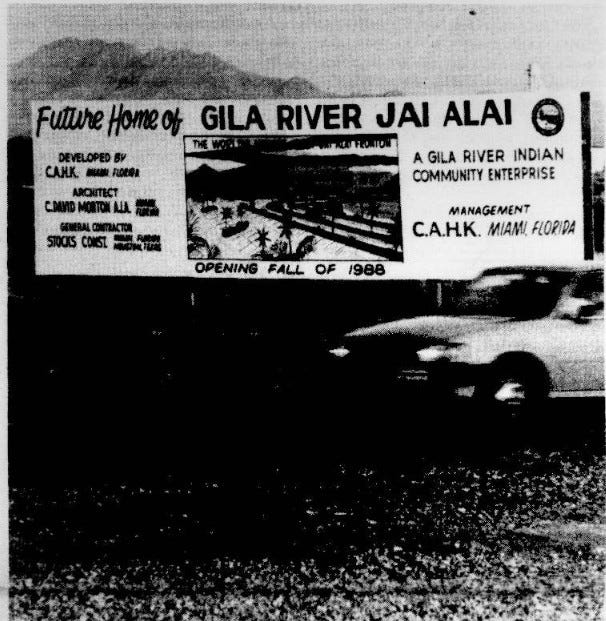
The same issue ran a full retrospective history piece on the jai alai saga, tracing the whole arc from 1985 forward — the state opposition, the BIA reversal, the Cabazon optimism, and the eventual collapse (09-88, p.2).
What Came Next
As you can probably guess, the end of Jai Alai wasn’t the end of gaming, the Community continued looking for ways to get into the field.
The September 1988 issue also ran a piece on Senate Bill S.555, a gaming bill reintroduced by Senator Daniel Inouye that would have allowed tribes to pursue various gaming activities - but only through agreements with states, and with some state jurisdiction on reservations as part of the deal.
Gila River opposed it. Heeley’s concern was pointed: “It opens the door to state civil jurisdiction on the reservation, and it somewhat smacks of application of state taxing on reservations” (09-88, p.2). Some Arizona tribes with existing bingo operations supported it. Gila River did not.
Inouye’s bill, revised, eventually became the Indian Gaming Regulatory Act (IRGA), signed into law in October 1988, just weeks after that September issue of the GRIN came out. The tribe had opposed the version on the table, but the amended IGRA is ultimately what opened the door for our gaming future.
The Casino Pivot
By January 1989, the pivot was underway. The tribal council at its January 4 meeting approved a $15,000 contract with an Albuquerque consulting firm — Grover, Stetson and Williams — to develop a management plan for a bingo operation. Governor Thomas White presented the proposal. A similar proposal had been rejected the previous spring. This time it passed (01-89, p.4).
But, in an alternate universe we could be heading down to a local Jai Alai fronton instead of the new San Tan Mountain Casino.
… well ok - probably not. Interest in Jai Alai pretty much died in the early and mid-90s. So probably a good thing GRIC didn’t go all in on the plan…
Anyway, the bingo management plan in January 1989 is where the modern gaming story really gets moving. But that is all a much longer article and a lot of it is outside the record of these issues.
Thanks for taking a trip down memory lane with me - if you are interested in checking out the stories I used to craft this article you can find them here:
Issue Page Title
05-87 2 Jai Alai Developer - Court Battle
05-87 2 If Gila River Wants Bingo…
07-87 7 Jai Alai Lawsuit - More Info
09-88 1 Closing the Door on Jai Alai and Pari-Mutuel Wagers
09-88 2 Jai Alai History
09-88 2 Senate Bill Covering Gaming Opposed by Gila River
1-89 4 Bingo Management Plan Firm Hired
You can find the full pdf archive at the original source Gila River Indian News or on my Gila River News Database