
Docket 228
The Long Wait for Per Cap
The Per Cap we have today is not the first set of per capita payments we ever had. In fact there were a few one-time per cap payments in history. The Docket 228 Saga is one that was detailed in the GRIN from 1987-1989 and I think it has some interesting history to share.
Lets get into it!
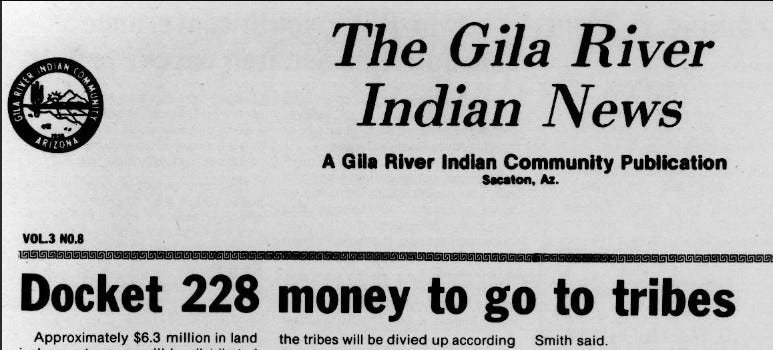
What Was The Gila River Indian Community Land Claim Case, Docket 228?
Docket 228 was compensation to the Gila River Indian Community, the Salt River Pima-Maricopa Indian Community, and the Ak Chin Indian Community for the denial of their rights to aboriginal land. This was a claim won in the U.S. Claims Court in ~April 1985.
Docket 228 was part of The Indian Claims Commission (ICC). The ICC was a US judicial panel established by Congress in 1946 to hear Native American grievances against the US government, primarily concerning land loss and broken treaties. It operating from 1946 to 1978, it awarded over $800 million for land taken at unfair prices, providing monetary compensation rather than land return.
But Docket 228 also represented a denial of rights for GRIC and other communities by forcing a cash settlement for stolen land. The settlement legally removed our title to our ancestral territory without returning any portions of it. This process also undervalued the land and was meant to legitimize the loss.
Basically think of it as the US Government’s way of paying for all our lands outside our reservation boundaries. But paying pennies on the dollar…
Some tribes refused to take the ICC settlement - one case is the Sioux related to Black Hills - they received a 100 million settlement in ~1980, but refused to accept it. It has now grown to over 2bn dollars, but the Sioux tribe maintains that the land was not and will never be for sale.
But, if a tribe took it or not, the federal government considered the land forfeit. They had and still have no intention of ever giving it back.
Back to Docket 228 at Gila River
This article isn’t all about that travesty though, we are going to look at what happened with the settlement when it came to Gila River.
The original award for the three tribes was about 6.3 million dollars minus ~10% of the total award deducted for attorney fees.
The money would be divided among the three tribes according to their enrollment numbers — Gila River with 10,370 members, Salt River with 4,352, and Ak Chin with 490 (08-87, p.5). During this time the money was sitting in investment accounts accumulating interest since 1985 while the tribes worked out their use plans (08-87, p.1).
Under the use plan approved by Congress and the Gila River Tribal Council, tribal members would receive 80 percent of the Community’s share as a per capita payment. The remaining 20 percent would stay with the tribal government as required by law, pending the development of a financial investment plan.
By the math available in August 1987, Gila River’s 80 percent per cap share worked out to roughly $330 per person — though the exact figure would depend on how much interest had accumulated by the time payments were actually made.
Simple enough on paper. What followed was anything but.
The Politics Behind the Money
The first sign of how charged the Docket 228 issue had become in the Community shows up in the very first issue of the GRIN in this period. January 1987 opens with a story about an effort to unseat two District 1 tribal council representatives through a recall election - Drake Lewis and Leona Thomas.
The recall was specifically tied to Docket 228.
You see, the original plan for all of the judgement money was to invest it rather than distribute most of it as per capita payments. When the money was first awarded to the Community the tribal council had made the decision to fully invest all the money.
But… then the tribal council reversed course in June 1986 under pressure from community members and passed a resolution calling for the 80/20 split. But many council members still believed that it was a bad idea for the long term good of the Community. For example Lewis and Thomas continued to support the original all-investment plan.
The recall petitions, circulated by Peter Miguel III and Eleanor Kumpula, read: “We, the undersigned, hereby petition the Gila River Indian Community Tribal Council for a recall election…for gross neglect of duty. (He/she) refused to represent the majority of the people in the matter of Docket 228, voting against us at every opportunity” (01-87, p.1).
The petitions had to be resubmitted because the original versions weren’t properly notarized to show the signatures were genuine, but once corrected, they moved forward through the Legislative Committee.
Both Lewis and Thomas ultimately survived the recall. But Drake Lewis lost his seat shortly after in the May 1987 election, narrowly beaten by Ardell Ruiz 38 votes to 50. A margin of just 12 votes (05-87, p.1).
I want to take a moment here - because I think this is a point of tension I still see today. I’ve had this per capita conversation with a lot of folks and it’s always a tense discussion.
First, Community members clearly wanted the per capita money. The recall fight over Lewis and Thomas, and Drake’s narrow loss at the ballot box shortly after, showed how strongly people felt that the judgement belonged to individual members — not to a tribal investment fund, and not to government programs designed to help people by proxy.
We see the same spirit come up later in the 2000’s when there was a fight to receive per capita payments from Gaming. The people wanted a higher split than the Council was willing to give.
On one side: trust the money to the government to run programs, build infrastructure, invest for the future. On the other: put it directly in people’s hands and let them decide what they need.
The Docket 228 fight suggests that at Gila River, community members have consistently landed on the same side of that argument. They have pushed for direct distribution over institutional control. The 1986 council resolution reversing the all-investment plan didn’t happen in a vacuum. It happened because people showed up and made their voices heard.
But… there’s a reasonable case for both sides. Tribal programs funded by retained money have built amazing things in our lifetime - hospitals, roads, housing, education infrastructure.
On the other hand there’s also something important in the principle that people are best positioned to decide what they need.
The politics eventually settled. The 80/20 split was put into law. But before any check could go out, the tribe had to do something that turned out to be a challenge: prove who was actually on the roll.
The Enrollment Problem
Once we got past the drama of the recall, there was also a deeper obstacle to actually getting checks in the mail - updating enrollment.
Before a per capita payment could be made, the tribe needed an approved membership roll. And that roll was a mess.
As BIA tribal operations officer Paul Smith put it bluntly in August 1987: “They have got a roll on which they have a lot of work to do, so it may be quite a while before they get a per capita distribution. It’s not accurate, there’s a lot of missing data” (08-87, p.1).
Governor Donald Antone Sr. pushed back, saying the BIA had changed the rules midway through the process by asking for a separate listing for the payout after the tribe was already halfway through updating its membership roll. “We ended up with two sets of rolls, and that’s when it began to fall apart,” he said (08-87, p.1).
The specific problems were what you might expect after years of inadequate record keeping. Women enrolled under maiden names who had married long ago. People using their grandparents’ names or middle names as first names. As Tina Notah, the Enrollment Office coordinator, explained some of the issues in July 1987: “A lot of people have taken on their grandparents’ names, a lot of them just didn’t like their names, and some use their middle name as their first name” (07-87, p.2).
The tribe had published a full list of eligible members in January 1987 as part of the legal requirement to give community members a chance to contest inclusions or omissions before the roll was certified. For each name on that list to be confirmed, the enrollment office had to complete an ancestral trace, verify blood degree, confirm tribal ID numbers, verify current address, and carefully check the enrollment date, since only those who had submitted applications by October 8, 1986 would be eligible for per capita payments.
It was painstaking work. The office only had six employees and was processing names at a rate of about 300 per month (05-89, p.5).
Two and a Half Years Later….
The January 1989 issue reported the enrollment office still had a minimum of three to four months of work left on the final 800 names, followed by a final approval process through the tribal council, the BIA, and then the Interior Secretary (01-89, p.1). The BIA superintendent was careful to clarify her office’s role: “Our only job is to certify the roll that the tribe sends to us” (01-89, p.1).
By May 1989 — two and a half years after we first saw the story - the end was finally in sight.
Only about 387 names remained to be added (05-89, p.1). The total amount sitting in the Gila River Docket 228 account at the end of March 1989 was $3,702,203.66 — the original settlement had earned more than $1.2 million in interest, coming in at about $30,000 to $32,000 a month from investments in 20 to 25 banks nationwide (05-89, p.5).
With roughly 10,000 names on the roll, each member was estimated to receive about $410. But as the roll crept closer to 11,000, the per capita payment would come in closer to about $375. A September 1989 target date was set for disbursement — though both the enrollment office and the BIA emphasized it was only a target, and that much more work was needed (05-89, p.5).
Members under 18 at the time of distribution would have their money held in trust until they turned 18, with interest added. And anyone who had been approved for tribal membership but had submitted their application after the October 8, 1986 cutoff would be on the tribal roll but left off the Docket 228 payment entirely.
Wait… $410? What is That in Today Money?
I want to take a minute to translate all this into inflation adjusted dollars for today.
So, imagine you are living in 1989 - you just found out all your ancestral lands finally went through the ICC and after all this time you get notified that you will be getting
Drum Roll……
~$400.
Inflation adjusted that is about $1,000 in 2025 money.
Yep… All our ancestral lands and we received about less than a year of gaming per capita. Crazy.
I keep thinking of this… we get more each year in per capita than we received for the settlement of all our ancestral lands.
Gross.
Conclusion
The papers in the archive don’t give a clean ending, though we know the payments went out at some point and the enrollment cleanup helped set the stage for the much cleaner systems we have today.
The per-cap vs. investment debate is real and I don’t think it’s going away. But beyond the Docket 228 drama about if the funds should be per capita or go toward supporting GRIC government, there is a deeper and sadder story about where those funds even came from - the loss of our lands.
Anyway - sorry to end on a bummer here, but .. history is a bummer sometimes.
Thanks for taking a trip down memory lane with me - if you are interested in checking out the stories I used to craft this article you can find them here:
Issue Page Title
01-87 1 Drive for Recall Election to Unseat District One Officials Continues
01-87 7 List of Eligible Members
07-87 2 Tribal Roll - Fixing Names and Marriages
08-87 1 Docket 228 Money Goes to Tribes
05-89 1 $3M in Docket 228 Money Almost Distributed
1-89 1 Docket 228 Payout Creeping Closer
You can find the full pdf archive on my Gila River News Database or at the original source Gila River Indian News