
87-89 - The Economic Wins at Gila River
Cool Economic Stories from the GRIN
The Economic Development Wins
There was a lot of amazing economic development in Gila River in the 80’s. This is a collection of some stories that I found and wanted to share.
Casa Blanca Market - RV Park
There was an expansion of Casa Blanca Market and the construction of a new RV park next door, both funded through a $317,000 Community Development Block Grant and a private loan from the San Tan Economic Development Corporation (01-87, p.4).
Work started in December 1986. The market expansion added 1,200 square feet of retail space and another 1,200 square feet for a new laundromat - the first laundromat in that part of the Community. An arcade porch and a road sign visible from the interstate were also added. The RV park was built right next to the Gila River Arts and Crafts Center with 22 full-service hookups of water and electricity to each space.
By October 1987 both were open and operating (10-87, p.2).
The RV park in particular was an interesting concept. It was a 50-space facility aimed at capturing some of the I-10 tourist traffic that passed by the Arts and Crafts Center every day. Emmett White of District 5 was awarded the landscaping subcontract (01-87, p.4). It opened at the beginning of tourist season with a hired manager from Casa Grande.
If it worked out is harder to track through the papers, but the January 1989 annual report noted it had been operating without adequate resources for some time after opening (01-89, p.5).
I also don’t ever remember seeing it growing up, so I wonder what happened to it.
Issue Page Title
01-87 4 RV Park Construction - Expansion at Casa Blanca Market
10-87 2 Casa Blanca Market Update
10-87 4 RV Park Opens
ATL Labs and the Guayule Experiment
Another fascinating economic story of this period was happening in Sacaton at the Amerind Agrotech Laboratories - ATL. Director Marc Mittleman, a botanist, was running an operation unlike anything else in the Community (07-87, p.3).
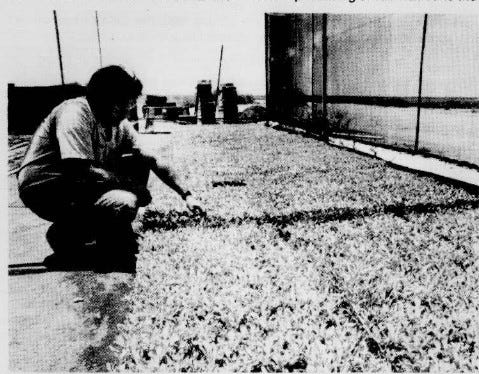
The flagship project was guayule — a desert shrub native to northern Mexico and the Big Bend area of Texas that produces natural rubber. The Department of Defense had determined that a domestic rubber supply was a national security priority, and poured nearly $10 million into exploring whether guayule could be commercially cultivated.
ATL had a $1.3 million DoD grant to maintain 400 acres of guayule and work on improving rubber yields. Firestone Rubber and Tire Company had an $8.3 million DoD grant to design and operate a prototype extraction plant.
Mittleman stated the production cost was running $1.50 to $1.80 per pound of rubber, while foreign rubber was selling at about 48 cents a pound. The math didn’t work yet, but the goal was to bring costs down while finding uses for byproducts like resins that could make the whole operation more cost-effective (07-87, p.3).
ATL wasn’t just about guayule though. It was exploring a range of underused Southwestern crops — gum tragacanth for food thickeners, Mexican oregano for the culinary market, Canaigre root for leather tanning, tepary beans as a traditional food crop ready for commercial development, and devil’s claw for basket makers. The laboratory’s whole philosophy was finding commercial value in crops that had been overlooked.
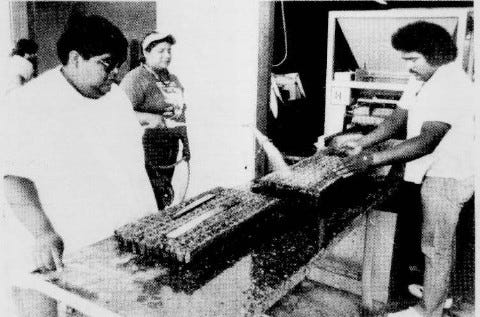
By January 1988 the Firestone processing plant at San Tan Industrial Park was dedicated — senators, representatives, and the Arizona governor on hand for the ribbon cutting. ATL had shipped about 240 tons of guayule to the pilot plant. The annual report this year noted ATL had 17 regular employees and up to 12 seasonal workers (01-89, p.7).

I wonder what ever happened to this development - I don’t know if I’d ever heard about it growing up, but would love to know more.
Issue Page Title
07-87 3 From Guayule to Devil’s Claw at Sacaton’s ATL Laboratory
01-88 3 Guayule Processing Plant Opens at San Tan Industrial
GRICUA and the Utility Fight
One of the bigger economic stories of the period was the tribe’s effort to get into the power business. This is one we know has a happy ending - our GRICUA enterprise is a leader in energy… but a lot of growth happened in these few years.
The Gila River Indian Community Utility Authority had been evolving since 1980, originally conceived to provide better electric service to the reservation and support economic development in the I-10 corridor.
Board chairman Cecil Antone explained the history in July 1987: a task force formed in 1980, four tribal board members appointed (Cecil Antone, Richard Thompson, Joe Manuel and Perry Sundust), then adding another three retired non-Indian utility industry experts advise the Community.
The experts were Harold Taylor, retired from Arizona Public Service (APS); Eugene Lauerman, Salt River Project (SRP); and Rex Tynes, Rural Electrification Administration (REA).
The authority spent years preparing by working with the REA for federal loans, negotiating with SRP and APS to eventually acquire their reservation-adjacent systems, and doing the groundwork to eventually take over power service (07-87, p.4).
The fight over hydroelectric power generation added another layer of complexity through 1988 … but that’s a story that deserves its own article someday.
Anyway, during this time a unique opening came with federal legislation to sell off the BIA’s San Carlos Irrigation Project electric system. If passed — and it had near-universal support including from the BIA itself — it would give GRICUA a shot at buying the system that already served most of the reservation, putting the tribe in the retail utility business (06-87, p.1).
Not a whole lot happening in this period, but cool to see the history and some of the steps for what has become an amazing part of our modern day energy independence and sovereignty.
Issue Page Title
06-87 1 BIA to Sell SCIP - Pave way for GRICUA
07-87 4 GRICUA History
07-88 1 Gila River Utility Mired in Fight Over Hydroelectricity
Some Other Quickies
The Olberg Trading Post Closes
One quick, mostly non-tribal economic story is that the The Olberg Trading Post was closed during this period. In 1988 the Post closed over a lease and water dispute (06-88, p.6).
I imagine that the tribe didn’t want to put time and money into supporting the business when it was focused on developing it’s own economic development.
The Post was a fixture of the Community since 1927 and it’s loss didn’t generate many articles during this period, but it’s pretty sad that Sixty-plus years of history were gone so suddenly.
Gila River Farms (Pima Farms) Hits 20 Years
During this period is when the Gila River Farms hit 20 years in existence. During this period there was a major inflow of federal cash to the Farms for crop diversification.
Ardell Ruiz of the farm board states this is the first time the Farms had ever asked the federal government for money, but that since so much development was happening in the metro areas, it left a lot of room for the Farms to expand to grow more citrus.
Gila River Baseball Stadium
Just a quick note that I didn’t see any follow up for - but GRIC was also proposed as a site for a baseball stadium for the Phoenix Firebirds.
Given we don’t have any major baseball stadiums in our lands today, I’m guessing it didn’t pan out. Still, I think worth showcasing that there were some major, large scale developments in planning phases at this time. Even when they don’t work out, it is cool to see the plans.
Also - side note I had to do a whole rabbithole on the Phoenix Firebirds - who eventually became the Tucson Sidewinders. Holy moly what a convoluted story!
Issue Page Title
06-88 6 Olberg Trading Post to Close
10-88 7 Gila River Farms Marks 20 Years
08-89 1 US Senate Approves 1.4M for Gila River Farms
08-89 1 Major League Baseball Stadium Considered for GRIC
What It All Adds Up To
It’s important to understand that much of the economic development we were doing on our own really only started in the 60’s - the Vh-Thaw-Hup-Ea-Ju plan really got things moving, and we started taking on larger and larger developments… but even into the 90’s the Community was learning and growing.
These few decades from ~1960-1990 were a major part of our growth and independence coming out of almost 70 years of really intense Federal Control. We had some growing pains that we will get to in the next article - but I want to focus on all the amazing progress we made!
I’ve always said - most local economic development in Sacaton or other districts is not going to make money. We just don’t have a large enough or rich enough population.
Someday we will get there, but sometimes the Government needs to build things for service to the people. Sometimes we need to subsidize and recognize it isn’t going to have the growth that modern business expect.
Anyway - Thanks for taking a trip down memory lane with me - if you are interested in checking out the stories I used to craft this article…
You can find the full pdf archive at the original source Gila River Indian News or on my Gila River News Database