
87-89 - Economic... Not so Wins at Gila River
A Collection of Economic Near Misses at Gila River
Alright - last article we talked about some of the really cool stuff happening around Gila River during this period for Economic Development… but it wasn’t all fun and games.
The late 1980s were a complicated time for economic development at Gila River. The tribe was managing a high-profile business failure and creating new rules for how our economic development would be managed.
I wanted to put together some of the interesting stories from this period. One of the front page stories was about the Sacaton Auto Supply, but there were some other economic mishaps as well.

The Sacaton Auto Supply Saga
No story better captures the tensions of economic development in this period than the Sacaton Auto Supply fiasco.
In case you didn’t know - we used to have an auto supply story in the Community. It is funny because I was just at Book Club the other day and I was chatting with some elders about this venture. They were asking what ever happened to it and how much it was helpful for everyone who was working on their cars…. Well we have some details on it from the newspaper.
So, I don’t know when the store opened - the paper doesn’t have that information, but we do know that in 1987 there was story that the store had accumulated $700,000 in debt over three years under manager Robert F. Lontkowski. So it might have opened around 1983 or 1984?
Either way, by the time the tribal council confronted the situation in 1986, the numbers were staggering. The tribe agreed to write off a $79,000 loss outright and assumed another $631,000 owed to vendors.
Valley National Bank alone was owed $200,000. The council directed the tribal legal counsel to look into holding Lontkowski responsible (02-87, p.5).
Ruben Norris was hired initially as an outside consultant and later appointed director of the Economic Development Office. He explained in February 1987, that the tribe had no visibility into the store’s finances while the debt was accumulating.
At the time, the accounting firm used to manage money had professional standards that stated financial records were confidential and only available to the person who signed the letter of engagement. In this case, that was Lontkowski.
Nobody else at the tribe had access to see the books (02-88, p.1).
This eventually led to some changes in the practice of the Tribe, but it was an expensive lesson. Still, the tribe believed that the store was important to the Community and it could eventually be saved.
The store stayed open. The tribe paid the bills, brought in new management, and tried to stabilize things.
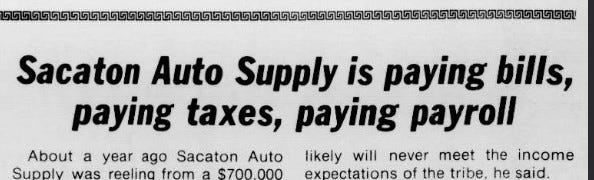
By October 1987 Norris reported the store was paying its current creditors, paying payroll, paying taxes to the tribe, and paying rent - but that the $300,000 the tribe had injected to give it new life was almost certainly never coming back. “I don’t know if the debt will ever be paid. It was in such a sick position that $300,000 was needed to give it new life,” he said (10-87, p.2).
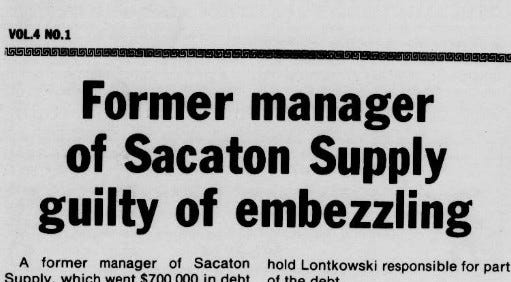
Then in January 1988 Lontkowski pleaded guilty in U.S. District Court to embezzling tribal funds. He was sentenced to five years probation and ordered to repay $49,061 - only a fraction of the $700,000 hole he had created. Thirteen other charges were dropped as part of the plea deal (01-88, p.1).
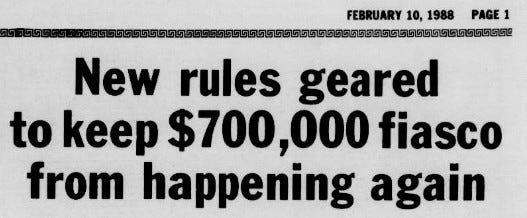
The February 1988 issue carried a follow-up on what the tribe had changed to prevent something like this from happening again.
New rules required that the community manager, tribal treasurer, the enterprise manager, and the Economic Development director to all sign the letter of engagement with the accounting firm. This gave multiple people access to financial information and reports were now filed directly with tribal council’s Economic Development Committee. “I think it’s a safeguard, one that wasn’t practiced in the past,” Norris said (02-88, p.1).
It was a painful lesson, but an instructive one. The Auto Supply story forced the tribe to build better oversight for its enterprises - something that would matter a great deal as the economic stakes got higher in the years ahead.
Eventually the business did close - I don’t quite know when, and I’d love any memories from folks who know. Or any other pictures of the place folks have!
Issue Page Title
02-87 5 Sacaton Auto Supply Debt
05-87 2 Businesses Losing Money
10-87 2 Sacaton Auto Supply Update
01-88 1 Sacaton Auto Supply - Embezzling!
02-88 1 New Rules to Stop Sacaton Auto Supply Fiasco
Other Struggling Tribal Enterprises and Businesses
The Auto Supply wasn’t alone in these struggles though.
Around the same time, the tribe’s Chandler Supply store closed its doors in November 1986, citing insolvency. Norris was tasked with settling that one too. Bankruptcy wasn’t an option - the tribe was the direct owner of the store, meaning a bankruptcy filing would have required the tribe itself to declare bankruptcy. So they just worked through paying the vendors one by one (02-87, p.5).
The May 1987 issue ran a broader accounting of what had happened across some of the tribal enterprise portfolio.
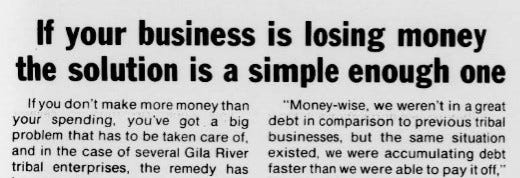
The Sandwich Shop at Sacaton had also been closed, losing money slowly. “Money-wise, we weren’t in a great debt in comparison to previous tribal businesses, but the same situation existed - we were accumulating debt faster than we were able to pay it off,” Norris said (05-87, p.2).
Chandler Supply was shut down entirely and debts were being paid off. Sacaton Chevron, Komatke Market, Casa Blanca Market and Gila River Farms were all undergoing financial assessments.
Norris was direct about what had happened: “What happens when you don’t make enough money to cover the debts? You go out of business. It’s pretty simple.” He credited the tribal council for choosing to close failing businesses rather than continue to subsidize them with community money (05-87, p.2).
Some of these businesses are still around today, so even with the struggles they were either subsidized or changed their business model to keep afloat. We still have our gas stations and the Gila River Farms is still in operation - so I have to hope that we eventually got to a place where we were making more money then we were spending…
I think something important to consider is that this was the growing pains of the Community working to build wealth for the people. One of the primary pillars in The Vh-Thaw-Hup-Ea-Ju plan in the 1960’s was centered around building local business, local economy, and local jobs.
Sometimes the gambles didn’t pay off, but during these decades the tribe was throwing spaghetti at the wall and trying to see what sticks. Yeah - sometimes the businesses failed or we had some type of financial or environmental disaster… that is part of growth.
We learned from the mistakes, we dusted off, and we moved on. And as you saw last article, some of these businesses worked out and have survived almost 30+ years!
Sometimes the spaghetti really sticks!
Anyway - Thanks for taking a trip down memory lane with me - if you are interested in checking out the stories I used to craft this article…
You can find the full pdf archive at the original source Gila River Indian News or on my Gila River News Database